
Headlines
It’s Over for Clover: Regional Restaurant Chain Closes
Boston-area vegetarian/locally sourced eatery couldn’t overcome economic headwinds.

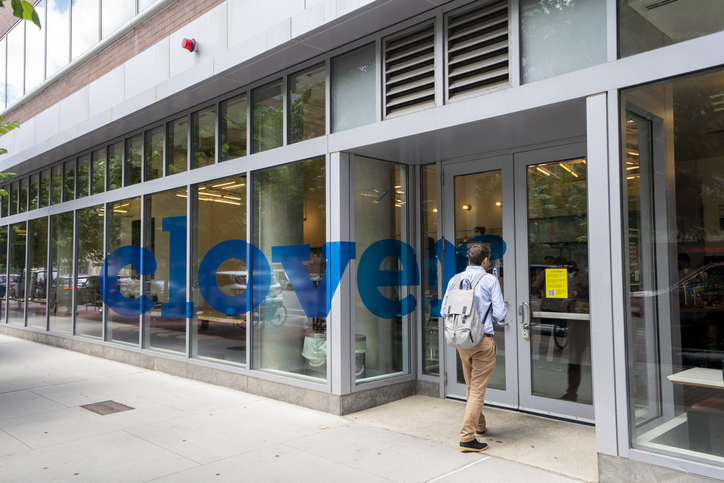 One of Clover’s now-shuttered restaurants, in Cambridge, Mass., circa 2022. Photo: hapabapa/iStock by Getty Images
Clover, a chain of 12 quick-serve restaurants and kiosks known for vegetarian dishes and locally sourced ingredients shut down late last month, The Boston Globe reports. The culprit: inflationary pressures that have caused ingredient prices to go up while also prompting many Clover customers to pare back on their spending — “a recipe for fiscal disaster,” as the Globe put it.
“We’re grappling with the impact of inflation,” CEO Julia Wrin Piper told the newspaper. “Our local farms are raising their prices. We’re experiencing the same pressures on every part of our supply chain that people are [experiencing] in their daily lives… We simply can’t keep up with inflationary pressures.”
The business was launched in 2008 as a food truck on the campus of MIT in Cambridge, Mass., by Ayr Muir, who had earned master’s degree in materials science there in 2001 before going on to study at Harvard Business School. His goal was to come up with vegetable-based recipes that meat lovers would like, to broaden the potential audience beyond vegetarians, with an eye toward sustainability. Over the following decade, Clover shifted from food trucks to brick-and-mortar shops, supported by a Cambridge commissary.
But Muir exited the company in 2023, shortly before Clover filed for Chapter 11 bankruptcy, following a poorly timed effort to open a new commissary in Hyde Park and a slowdown in foot traffic brought about by remote work trends during the COVID-19 pandemic.
For a while, it looked like the chain had a new lease on life after emerging successfully from an expedited bankruptcy the following year. But it wasn’t to be.
Though an issue for several years, inflation significantly ate away at revenue and drove up expenses earlier this year, Wrin Piper said, at roughly the time that the United States and Israel began the war with Iran, causing oil prices to shoot up. Most of Clover’s ingredients, she added, cost 30% to 50% more than two years ago.
Advertisement“Clover is a very special place,” she told the Globe. “You’ll never find a more standup group of mission-driven, smart people… We worked elbow to elbow with each other. We really enjoyed bringing joy to Boston, to our customers.”
In the end, that wasn’t enough, Wrin Piper said, noting that Clover’s struggles illustrate the challenges of relying on local food sources without government contracts or other subsidies to help defray costs.




It’s Over for Clover: Regional Restaurant Chain Closes

K-Beauty Continues U.S. Growth

Dick’s Sporting Goods Debuts East Hampton Pop-Up

The 2024 Shop! Design Awards Winners

Mission + Pillars

Shop! Ideation 2022 Recap (Photo Gallery)

MasterClass – Beyond the Screen: Specialty Retail Media Networks That Transform the In-Store Experience

MasterClass – Designing for Impact: Transforming Visual Merchandising with Display Innovation and AI

MasterClass – Insights into the Journey Towards the Most Sustainable and Effective Promotions in Retail

Bulletin
Sign up for our bulletins now and never miss out on essential industry news, updates and compelling retail inspiration!
-
 Headlines2 weeks ago
A Craft Brewer Grows in Brooklyn
-

 Events2 weeks ago
PHOTOS: Shop! MarketPlace 2026 Recap
-

 Headlines2 weeks ago
On Our Radar: Carolina Herrera, San Diego
-

 Shop! Press Releases2 weeks ago
Shop! MarketPlace 2026 Celebrates the Best-in-Class from Around the World
-
 Headlines2 weeks ago
LVMH Sells Marc Jacobs Intl. to WHP and G-III
-
 Headlines2 weeks ago
Brands on the Move: Lee and Roberto Cavalli
-

 Headlines2 weeks ago
Claire’s Merch Headed to Walmart, Kohl’s and CVS
-
 Headlines2 weeks ago
The First Casualty of Jewelry Retail? Too Often, It’s Lunch.