
Headlines
Target Seeks to Up its Grocery Game
Retailer working to improve its food-shopping experience by injecting it with more style and design.

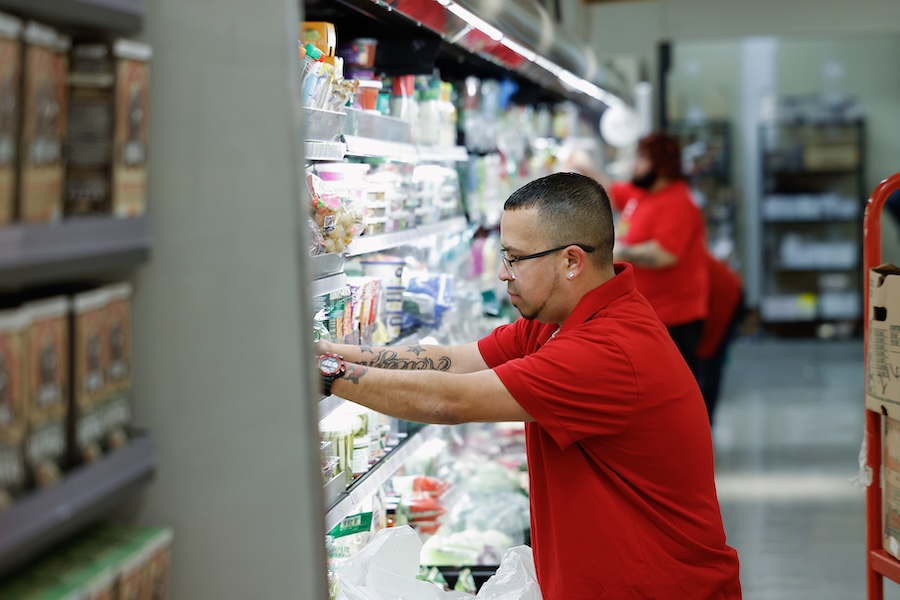 Workers stock merchandise in the grocery section of a Target. Photo: Jeff Schear/Getty Images for Target)
Though Minneapolis-based Target has spent years trying to become a major player in grocery, it remains a secondary stop for many shoppers. That’s the conclusion of a recent in-depth article that ran in the brand’s hometown paper, The Minnesota Star Tribune. (Though that article devoted considerable space to looking at Target’s grocery strategy for its hometown, it also included information on the brand’s chain-wide challenges in that sector.)
Groceries account for just over 20% of Target’s sales, compared with more than half at rival Walmart, and purchases are often incremental rather than part of a weekly stock-up.
At its investor day last month, Target acknowledged it needs to sharpen its grocery strategy as part of a broader effort to pull out of a sales slump that has lingered since the pandemic.
“Shopping for food at Target should feel distinctly Target,” said Cara Sylvester, Target’s Chief Merchant, at the retailer’s financial community meeting in March. “Delightful, joyful, unlike what you’ll find anywhere else.”
In Target’s preview of its revamped grocery strategy at that session, executives showed off displays featuring items labeled grain-free, gluten-free and high-protein.
The company is also earmarking a significant chunk of its $5 billion investment this year for grocery, expanding the section’s footprint in 130 remodeled stores and leaning into what executives describe as its strength in “style and design.”
AdvertisementWhile acknowledging the need to refine the strategy, Target executives note that food and beverage sales have grown from $15 billion in 2019 to $25 billion in 2025, driven in part by expanded health and wellness offerings.
Target’s overall challenge, said Amanda Lai, Director of Food Industry Practice at Chicago-based retail consultant McMillanDoolittle, is that it’s “not the cheapest,” but also not “the most differentiated or highest quality,” making it harder to compete with value-driven chains and upscale grocers.
Target, for its part, says it “is writing a new chapter focused on growth, with food and beverage as a foundation of this work,” a spokeswoman told the newspaper.





Target Seeks to Up its Grocery Game

Mother’s Day Spending Expected to Hit Record $38B

Tariff-Refund Portal Launched by US Government

The 2024 Shop! Design Awards Winners

Mission + Pillars

Shop! Ideation 2022 Recap (Photo Gallery)

MasterClass – Beyond the Screen: Specialty Retail Media Networks That Transform the In-Store Experience

MasterClass – Designing for Impact: Transforming Visual Merchandising with Display Innovation and AI

MasterClass – Insights into the Journey Towards the Most Sustainable and Effective Promotions in Retail

Bulletin
Sign up for our bulletins now and never miss out on essential industry news, updates and compelling retail inspiration!
-
 Headlines1 week ago
Coming Soon to a Mall Near You
-

 Headlines2 weeks ago
Furniture Retailers Under Major Strain: Report
-
 Events1 week ago
Don’t Miss These Retail Leaders Speak at Shop! MarketPlace 2026
-

 Headlines2 weeks ago
Signs of the Times at 2026 ISA Sign Expo
-

 Headlines2 weeks ago
Independent Jeweler Sales Rose 12% in March — But Fewer Customers Are Buying
-

 Headlines2 weeks ago
RH Focuses on Overseas Expansion
-
 Headlines2 weeks ago
2 More Nordstrom Local Service Hubs on Tap for California
-
 Headlines1 week ago
Walmart Again Reigns Atop Global Retailer Rankings by NRF/Kantar