
Headlines
Incomplete or Inaccurate Inventory Info Costly for Retailers
Front-line workers at large store chains say AI not as helpful as expected in dealing with that problem.

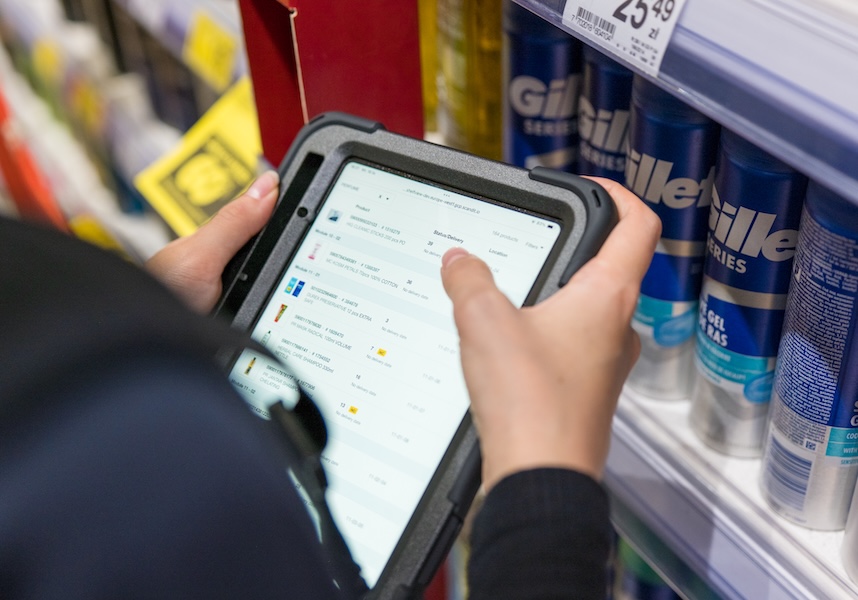 A store associate using a tablet to check inventory records in a store aisle. A recent survey found that data in such systems is often in error. Photo: Courtesy of Scandit
Retail’s race to deploy AI is running ahead of the quality of the data about what’s actually on store shelves, a recent survey of more than 2200 front-line retail associates in the U.S., Canada, U.K and three other countries found. Such workers reported that in-stock information matches what they find on the shelf just 46% of the time, and that only 8% trust store data completely.
This creates a costly gap between what the system says, what is actually in the store and what customers experience.
“Retailers do not have an AI adoption problem as much as a store truth problem,” said Samuel Mueller, CEO and co-founder of Scandit, which performed the survey. “Associates are spending valuable time repairing these gaps, yet much of that work disappears into unofficial tracking systems. Before retailers ask AI to make more decisions based on inaccurate store data, they need a shared, accurate view of what is actually happening on the shelf and across their stores.”
That lack of accurate info is already being absorbed by labor. Associates estimate they would each get back more than 4.4 hours a week, or nearly six working weeks a year, if they had data they could trust. That time amounts to millions in recoverable labor hours. A retailer employing 10,000 store associates, for example, faces more than $41 million a year in labor cost tied to compensating for the gap.
Extrapolating that time across the entire pool of retail associates in the U.S., as tabulated by the U.S. Bureau of Labor Statistics, inaccurate data could cost the retail industry as much as $22 billion annually.
And when the system is wrong, associates do what they have to do to keep the store running. Nearly half (49%) correct the record themselves and 44% raise a stock adjustment. But among associates who take action, 42% bypass the official system entirely, while 68% use at least one informal method, including paper notes, team chats, personal phone photos and apps or memory.
AdvertisementThe result is a “shadow store” in which vital information exists outside the record that head office, dashboards and AI systems rely on. Proactively working to fill those info gaps can make the retailers involved much more efficient, the study notes.
Click here for more results from the survey, as well as more details on the kinds of retailers in which countries were surveyed.




Incomplete or Inaccurate Inventory Info Costly for Retailers

Photo Tour: JanSport Debuts Global Flagship in Seoul

The “Erewhon-ification” of Dining and Other Trends

The 2024 Shop! Design Awards Winners

Mission + Pillars

Shop! Ideation 2022 Recap (Photo Gallery)

MasterClass – Beyond the Screen: Specialty Retail Media Networks That Transform the In-Store Experience

MasterClass – Designing for Impact: Transforming Visual Merchandising with Display Innovation and AI

MasterClass – Insights into the Journey Towards the Most Sustainable and Effective Promotions in Retail

Bulletin
Sign up for our bulletins now and never miss out on essential industry news, updates and compelling retail inspiration!
-

 Blogs & Perspectives2 weeks ago
Cole Haan’s 600th Store Opens in Boston
-

 Blogs & Perspectives2 weeks ago
Bath & Body Works Unveils Concept Store
-

 Headlines2 weeks ago
Holiday Pulse: The Latest Consumer Surveys
-

 Blogs & Perspectives2 weeks ago
Store Openings: FP Movement, PriceSmart and Revolve
-

 Blogs & Perspectives2 weeks ago
Solomon Brothers Jewelers Acquires Washington, DC-Area Retailer Mervis Diamond Importers
-

 Headlines2 weeks ago
Simon to Buy High-Profile Open-Air Center
-

 Blogs & Perspectives2 weeks ago
Bageterie Boulevard Heads to North America and Elsewhere
-

 Blogs & Perspectives2 weeks ago
Marc Jacobs Plans Growth in Greater China